
Cymatics: Visual Proof of Vibration


Water being a strong conductor for sound, imagine how sound affects your body (considering the human body is made up of around 60% water)and how it can assist rearranging dissonance = dis-ease into patterns of a natural state of coherence.
Cymatics can be traced back at least 1000 years to African tribes who used the taut skin of drums sprinkled with small grains to divine future events. The drum is one of the oldest known musical instruments and the effects of sand on a vibrating drumhead have probably been known for millennia.

Leonardo Da Vinci (1452–1519) noticed that vibrating a wooden table on which dust lay created various shapes. ‘I say then that when a table is struck in different places the dust that is upon it is reduced to various shapes of mounds and tiny hillocks. The dust descends from the hypotenuse of these hillocks, enters beneath their base, and raises itself again around the axis of the point of the hillock.’

Galileo Galilei (1564–1642) described scraping a brass plate with a chisel and noticed a ‘long row of fine streaks, parallel and equidistant from one another,’ presumably caused by the brass filings dancing on the surface of the plate and finding safe haven in a series of parallel nodal striations.
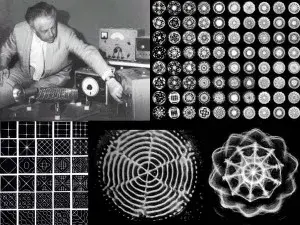
Ernst Chladni, an 18th-century German physicist, is famous for studying the physics of sound by bowing a metal plate with sand on it to create simple geometric shapes. His work was foundational in the future development of Cymatics.

More than a century later, Dr. Hans Jenny started to experiment with different liquids and solids and continuous vibrating frequencies to test the physics of sound further. It was Jenny was coined the term ‘Cymatics’containing the Greek word, ‘Kyma’ which means ‘wave.’ His seminal research was compiled in a book of the same name and contains hundreds of photos showing his results.
According to the acoustic-physics researcher, John Stuart Reid, during his acoustics research mission to the Great Pyramid of Giza, in 1997, Reid claims that his chronic pain in the lower back was healed while conducting cymatic experiments in the pyramid.

The Great Pyramid of Giza was designed to reverberate in order to increase the sound energy from ritualistic chants. In fact, a greek traveler by the name of Demetrius, circa 200 B.C., wrote that the Egyptians used vowel sounds in their rituals: ‘In Egypt, when priests sing hymns to the Gods they sing the seven vowels in due succession and the sound has such euphony that men listen to it instead of the flute and the lyre.’
Late archaeologist Abd’el Hakim Awyan was an indigenous wisdom keeper who saw Egypt through the eyes of his ancestors. Says he in the documentary The Pyramid Code that pyramid structures along the Band of Peace are harmonic structures that used sound (of running water through an underground tunnel) to heal illnesses. He explains, “Every chamber within the pyramid has a specific harmonic replicating the harmonics of the cavities of the human body. Sound healing techniques were then used to restore the patient’s body to the correct harmonics.”
Further taking the example of the Bent Pyramid of Sneferu in Dashur, Hakim says, Sen means ‘double’ and nefer means ‘harmony’ and that the bent pyramid has two different chambers that produce two distinct sound frequencies. These frequencies are in turn amplified within the pyramid walls to create huge fields of harmonic resonance that restore balancewithin a human body.
I’ll leave you with a few videos to witness for yourself what sound does to matter…now, imagine how sound affects your body on a cellular level.
Some “Sound for Thought”…

Crystl Sn
Level Up Your Frequency™
Comments